





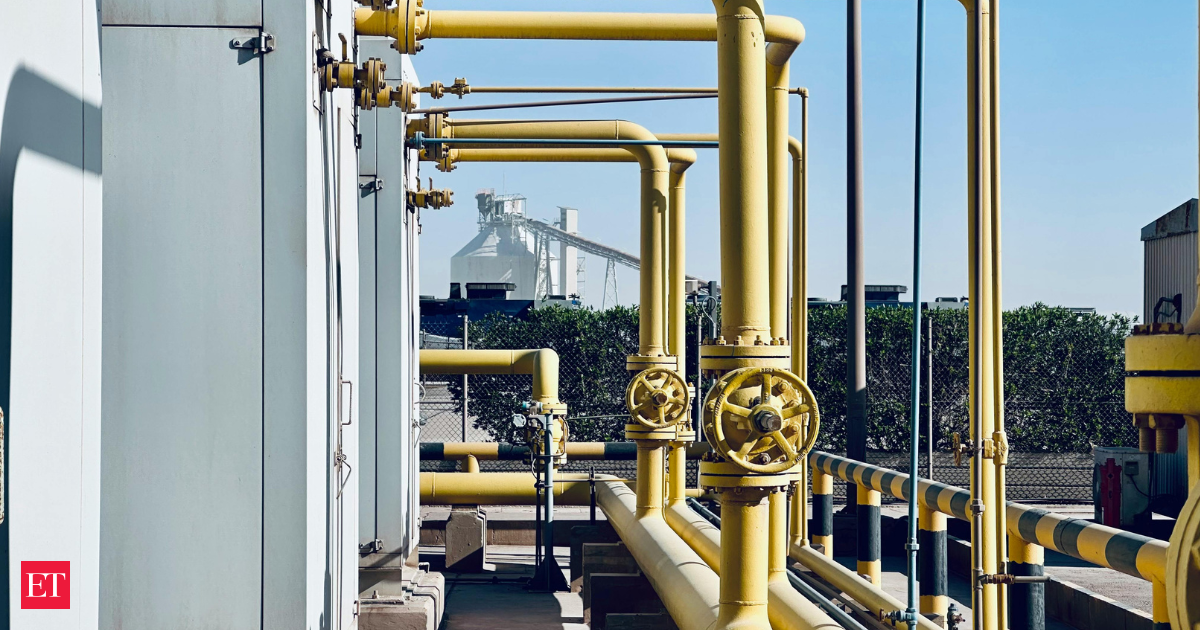
The push reflects the country’s high exposure to LNG supply shocks and price volatility, and shows how it lags manufacturing rivals such as China.
The ministry is set to direct state-run GAIL, Engineers India and Indian Oil Corp to prepare a detailed feasibility report, senior officials told ET. They said the government is working off a pre-feasibility study submitted by The South Asia Gas Enterprise (SAGE), a New Delhi-based private sector consortium.
Stable, Cost-Competitive Supply
A positive detailed feasibility report will pave the way for formal government-level negotiations with Oman on gas supply, financing and project execution.




Live Events
“India needs to move beyond dependence on LNG spot markets,” one of the officials said. “A dedicated pipeline from West Asia gives us stable, cost-competitive gas without depending on any transit country or maritime choke point.”
Read more: Aditya Birla group, KKR left in race for Sprng Energy
India’s natural gas demand is steadily rising as the energy-hungry country attempts to enhance the share of gas in its primary energy mix. Current consumption stands at roughly 190-195 million standard cubic metres per day (mmscmd) and is projected to reach nearly 290-300 mmscmd by 2030. Estimates suggest LNG imports alone could reach 180-200 mmscmd by the end of this decade.
Project Details
The proposed Middle East-India Deep-water Pipeline (MEIDP) will stretch 2,000 km under the Arabian Sea, connecting Oman directly to the Gujarat coast. It will deliver around 31 mmscmd of natural gas.
Read more: A username could one day suffice as your address
The route will be designed to pass through the Arabian Sea via Oman and UAE, avoiding geopolitically sensitive regions, and would allow India to access gas from Oman, UAE, Saudi Arabia, Iran, Turkmenistan, and Qatar, a region holding 2,500 trillion cubic feet of gas reserves. The pipeline could run at depths of up to 3,450 metres, making it one of the deepest undersea pipelines ever attempted globally.
Recent technical studies have confirmed the project as feasible owing to advances in deep-sea pipe-laying and pipe-repair technology. SAGE, per its government submissions, has already laid around 3,000 metres of tactical test pipeline along the route at a cost of around ₹25 crore to study seabed conditions. ET could not independently verify this figure.
Wake-Up Call
Nearly two-thirds of India’s LNG imports transited the Strait of Hormuz in 2025. When Iran effectively shut the route in late February following the conflict with the US and Israel, global LNG supply fell by more than 20%, triggering price spikes.
Asian spot LNG prices, represented by the Platts JKM benchmark, have experienced sharp swings in recent years. Prices that hovered at $10-12 per MMBtu during stable periods surged to $24-25 per MMBtu due to the geopolitical crisis.
The Hormuz disruption has underscored India’s vulnerability to both physical supply shocks and price swings. “Dependence on a single maritime chokepoint is no longer viable,” said the official cited above. “This is now a national security imperative.”
Alongside pipelines, policymakers are flagging a critical gap with the absence of gas storage.
Unlike crude, India has virtually no strategic gas reserves, leaving it exposed to volatile spot markets and unable to store cheap gas for times of crises. Currently, India has 22-24 LNG storage tanks across regasification terminals, with an estimated storage capacity of roughly 2-2.5 billion cubic metres (BCM). This volume represents only 10-12 days of national gas consumption.
“India has debated an Oman pipeline for decades,” said Ashutosh Karnatak, former chairman and managing director, GAIL. “The Hormuz crisis has forced action. A pipeline offers price predictability and supply security that LNG cannot match.”
The move also highlights India’s gap with China in securing pipeline gas and storage. Beijing has spent two decades building multiple overland pipeline corridors—precisely the kind of supply security that insulated it from the Hormuz shock.
China’s Power of Siberia pipeline began operations in December 2019 and delivers up to 38 bcm per year from Siberian gas fields at full capacity. A second pipeline, Power of Siberia 2, with a proposed capacity of 50 bcm per year via Mongolia, is under negotiation. From Central Asia, China already has three parallel pipelines from Turkmenistan. These have a combined capacity of 55 bcm per year. A fourth line is under construction that would take total capacity to 85 bcm per year.
Also, China’s total gas storage capacity is expected to reach 80 bcm by end-2026, covering roughly 20% of its annual consumption. India has no comparable strategic gas reserve.
The proposed Oman pipeline could help bridge key demand gaps. The fertiliser sector alone needs 46-50 mmscmd, while city gas distribution continues to expand rapidly.


