







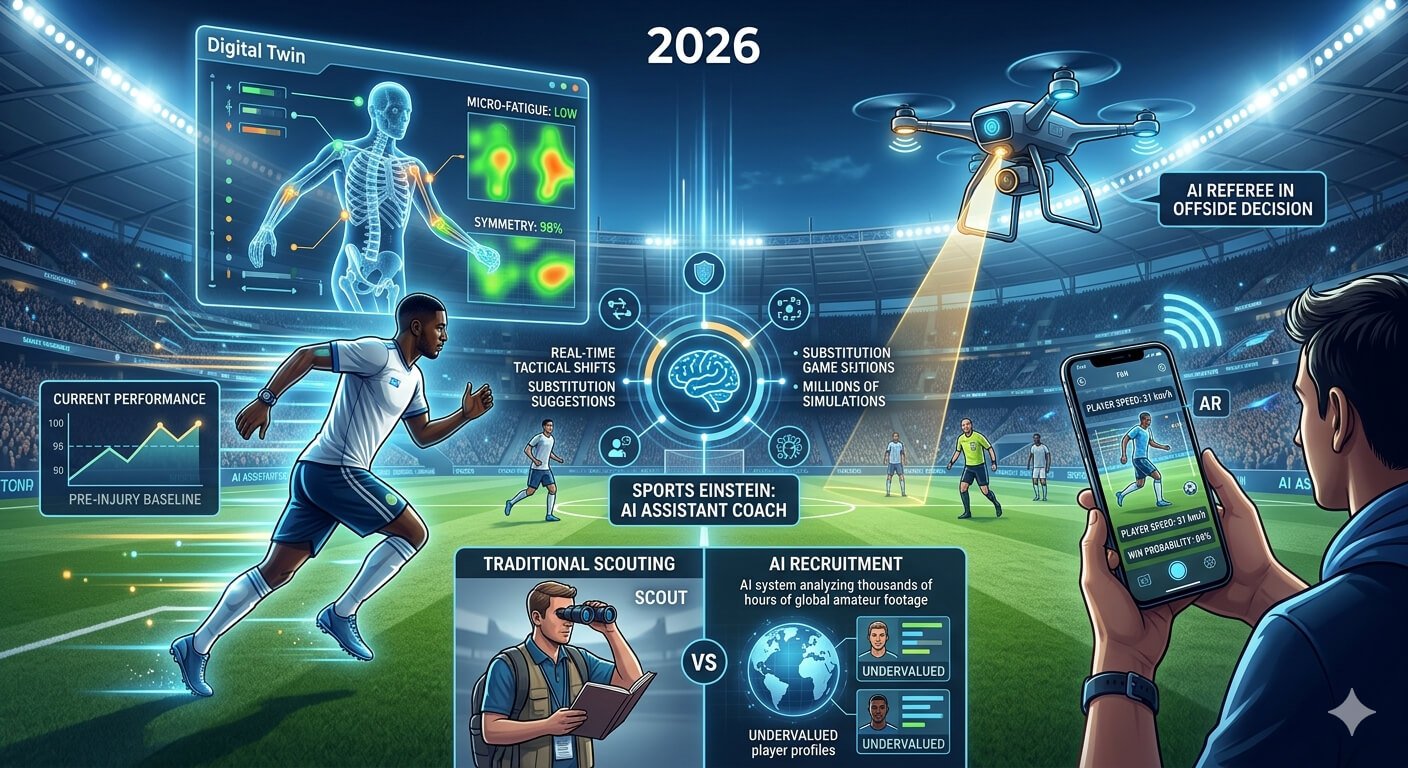
As we move through 2026, the roar of the crowd is being met with the hum of the processor. Artificial Intelligence has officially stepped out of the back office and onto the playing field, fundamentally altering how athletes train, how coaches strategize, and how you experience the game.
Here is an easy-to-understand blog layout for “The Rise of AI in Sports” that highlights the biggest shifts happening right now.
The “Digital Athlete”: Predicting the Future of Performance
The most valuable asset in any sport is the player. In 2026, teams are using AI to build “Digital Twins” of their athletes.
- Injury Prevention: By analyzing data from wearables and camera feeds, AI can spot “micro-fatigue”—tiny changes in a player’s movement that signal a high risk of injury before it happens.
- Precision Coaching: Apps now use smartphone cameras to analyze a golfer’s swing or a striker’s kick in 3D, comparing it to “perfect” professional mechanics to give instant feedback.
The End of Human Error? AI Officiating
Officiating is no longer just about the referee’s eyes. AI is providing a “Source of Truth” that is faster and more accurate than ever.
- The Automated Strike Zone: Following successful trials, 2026 marks the widespread use of AI-driven ball-strike challenges in baseball, where cameras track every pitch with millimeter precision.
- Real-Time Offside: In soccer, AI models now track 29 data points on every player’s body 50 times per second, making offside calls in under half a second—keeping the game fast and fair.
Scouting the “Invisible” Talent
Scouting used to require a massive travel budget and a lot of luck. Today, it’s about AI Recruitment.
- The Global Net: AI scouting platforms can “watch” thousands of hours of amateur footage from across the world, identifying “undervalued” players whose stats or movements match those of top-tier stars.
- Skill Projection: AI doesn’t just look at how a player performs today; it uses historical data to predict how they will develop over the next five years.
Fan Engagement 2.0: The “You-First” Experience
For fans, 2026 is the year the “one-size-fits-all” broadcast died.
- Personalized Highlights: Can’t watch the whole game? AI automatically generates a 2-minute highlight reel based specifically on your favorite players or team.
- Immersive Stats: Using AR (Augmented Reality), fans at home or in the stadium can point their phones at the field to see live speed tracking, win probabilities, and player heat maps overlaid on the action.
- Smart Stadiums: Biometric entry and AI-managed concessions mean no more 20-minute lines for a hot dog. Your “identity” is your ticket and your wallet.
Strategy: The AI Assistant Coach
Coaches aren’t being replaced; they are being upgraded.
- Game Simulations: Before a match even starts, AI models run millions of simulations to find the best lineup or the most effective tactical shift against a specific opponent.
- In-Game Decisions: Should you go for it on 4th down? AI provides real-time “win probability” data to the sidelines, helping coaches make high-pressure decisions with data-backed confidence
2026 Deep Dive: The AI Sports Ecosystem
1. The “Sports Einstein”: AI as the Assistant Coach
In 2026, the term “Assistant Coach” often refers to an AI agent.
- Real-Time Tactical Shifts: During a game, AI agents analyze live video feeds to suggest substitutions. If a defender’s “Limb Velocity” drops by 10%, the AI flags them for potential fatigue-related errors before they happen.
- Opponent Digital Twins: Teams now run pre-game scrimmages against “Digital Twins” of their opponents. These models use years of data to mimic exactly how a rival quarterback or striker reacts under pressure.
- The Voice in the Ear: Coaches use AI earpieces that provide “win-probability” updates in real-time, helping them decide whether to play it safe or take a high-stakes risk.
2. The Scouting Revolution: “Finding the Needle in the Haystack”
Scouting is no longer limited to high-budget teams. AI has democratized talent discovery.
- Transfer Portal Agents: AI agents now scan social media, news, and public game data to help teams prioritize transfers. They can even surface “hidden context,” like why a player missed games—distinguishing between performance issues and off-field recovery.
- Expected Threat (xT): Beyond basic stats, AI calculates “Expected Threat,” measuring how much a player’s movement increases their team’s chance of scoring, even if they never touch the ball. This helps find “unsung heroes” who were previously invisible to scouts.
3. Smart Stadiums & The “Frictionless” Fan
Attending a game in 2026 feels like stepping into the future.
- Identity-Driven Environments: Venues like the Intuit Dome have set the standard. Fans enter using facial recognition and pay for food with a glance. No lines, no wallets, no missed plays.
- Inclusive Tech: AI is making sports accessible to everyone. Tools like OneCourt translate live gameplay into vibrations or audio commentary for fans with visual impairments, ensuring the “roar of the crowd” is shared by all.
- 5G & Edge Computing: With upgraded stadium infrastructure, fans can point their phones at the pitch to see “AR Heatmaps” of player movements or instant replays from 20 different angles.
4. Precision Medicine: Mapping the Recovery Curve
Injury management has shifted from “subjective feeling” to “objective benchmarking.”
- Personalized Normative Baselines: AI doesn’t compare an athlete to a “league average.” It compares them to their own “Digital Twin” established before they were injured.
- The “Traffic Light” Logic: Medical staff use a simple AI dashboard. Green means full performance; Yellow flags “micro-fatigue” (compensatory mechanics); Red warns of an imminent tear.
- Symmetry Benchmarking: A player is only cleared for contact when their current movement matches their pre-injury digital signature with 98% accuracy.
Conclusion: The Human-AI Partnership
The biggest takeaway for 2026 isn’t that AI is replacing the passion of sports—it’s that it’s protecting it. By keeping players healthier, making scouting fairer, and making stadiums more inclusive, technology is ensuring that the “beautiful game” stays beautiful for the next generation.
FAQs
1. How does AI prevent injuries?
Wearables track “micro-fatigue” and movement changes, alerting coaches before a strain or tear occurs.
2. Will AI replace human referees?
Not entirely. It provides a “Source of Truth” for objective calls (like offsides), while humans manage game flow.
3. What is a “Digital Twin” in sports?
A virtual model of an athlete used to simulate performance, test recovery, and predict career growth.
4. How does AI help in scouting?
It analyzes thousands of hours of global footage to find “undervalued” talent that human scouts might miss.
5. How does AI improve the fan experience?
Through personalized highlight reels, AR stat overlays, and “frictionless” stadiums with no lines.
6. Can AI predict game outcomes?
Yes, by running millions of simulations based on live player data, weather, and historical tactics.


