




Building on the famous 2011 quote “Software is eating the world,” the tech landscape in 2026 has reached a new turning point: AI is now eating software.
Here is an easy-to-understand blog layout with key talking points to help you explain this shift to your readers.
What Does “AI Is Eating Software” Actually Mean?
In the past, software was a set of rigid instructions written by humans. Today, we are moving toward AI-native development.+1
- The Shift: We are moving from Syntax (how to write code) to Intent (what we want the code to do).
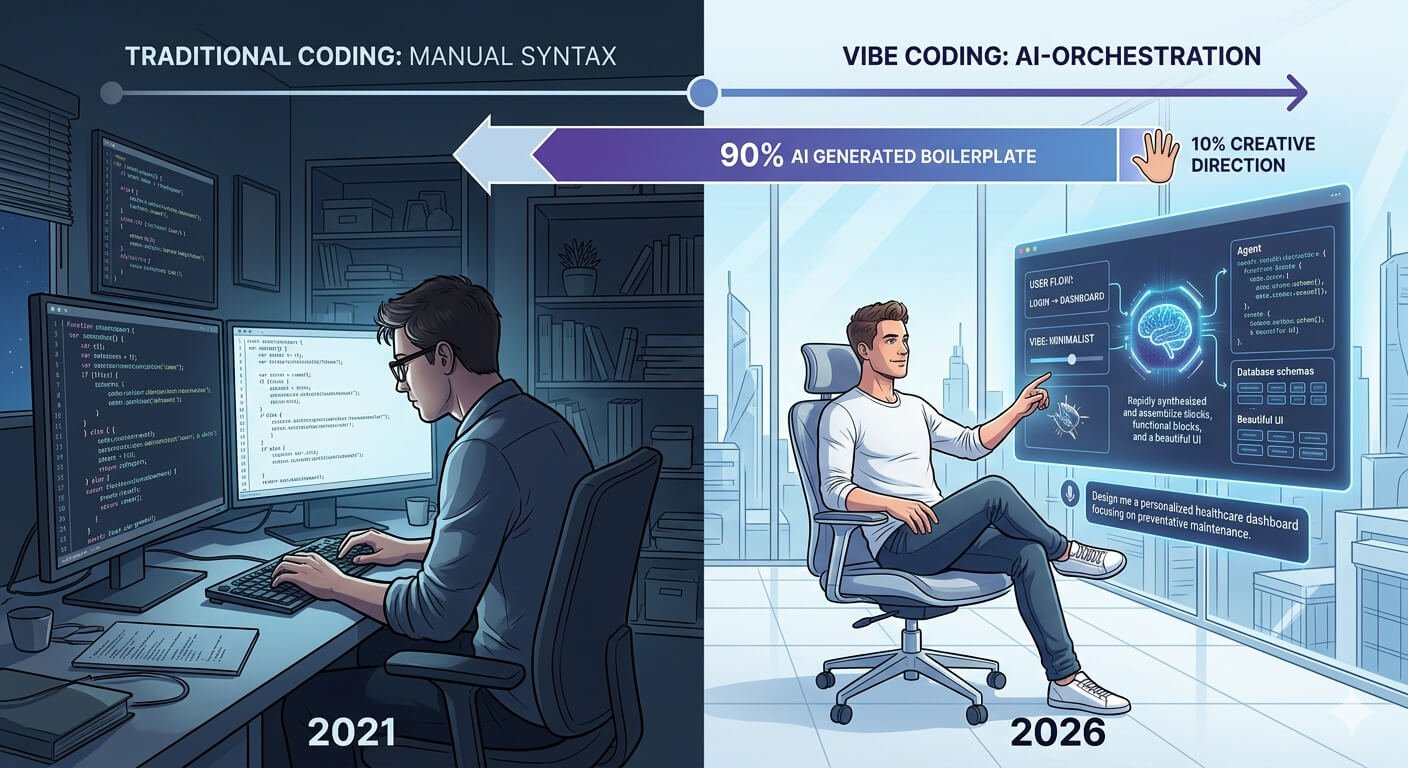
- Vibe Coding: A new term for 2026 where developers describe the “vibe” or requirements of an app in plain English, and AI handles the heavy lifting of building it.
Is Traditional Coding Dead? (The Reality Check)
No, but it is changing. While you don’t need to type every bracket anymore, you still need to understand how systems work.
- From Builders to Architects: Developers are becoming “AI Orchestrators.” Instead of laying every brick, they are now the architects designing the building and making sure the AI “robots” build it correctly.
- 90% AI-Generated: By 2026, it is estimated that up to 90% of boilerplate and standard code is generated by AI. Humans focus on the critical 10%—the creative logic and security.
Why This Is a Game-Changer
- Speed: Tasks that took weeks now take hours. You can build a prototype in a single afternoon.
- Infinite Customization: AI allows software to adapt to the user. Instead of one interface for everyone, AI can create a personalized experience for every individual user.+1
- Lower Barrier to Entry: You don’t need a CS degree to build a functional app, but you do need “Product Thinking.”
The New “Must-Have” Skills for 2026
If syntax is less important, what should you learn?
- Prompt Engineering: Learning how to give precise, structured instructions to AI agents.
- System Design: Understanding how different parts of a program (database, frontend, API) talk to each other.
- Code Reviewing: Since AI writes the code, your job is to be the “Supervising Editor” who spots mistakes and security flaws.
The Risks: What Could Go Wrong?
- Technical Debt: If you let AI write code you don’t understand, it becomes very hard to fix when things break.
- Security Mirages: AI often prioritizes making things “work” over making them “secure.”
- The “Good Enough” Trap: Software might become “standardized” and lose the unique, revolutionary spark that human creativity brings.
The 2026 Developer Blueprint: Beyond the Hype
1. From “Coding” to “Vibe Coding”
The hottest trend in 2026 is Vibe Coding. Coined by Andrej Karpathy, it describes a shift where developers focus on the “feel” and logic of an application rather than the syntax.
- The Intent-Driven Loop: You no longer start with a blank script. You start with Intent → Spec → Generate → Review.
- One Change Rule: To keep AI from getting “confused,” modern developers follow the rule of requesting only one logic change at a time.
- Plain English as a Compiler: English (or any natural language) has effectively become the highest-level programming language.
2. The Rise of “Agentic” Software
In 2011, software was a tool you used. In 2026, software is an agent that works for you.
- Self-Healing Code: AI agents now monitor apps in real-time. If a bug is detected, the agent autonomously writes a fix, tests it, and deploys it before the user even notices.
- Multi-Agent Orchestration: Instead of one giant codebase, we are seeing “teams” of AI agents (e.g., a Database Agent talking to a Frontend Agent) building micro-services collaboratively.
3. The “Build vs. Buy” Flip
For a long time, companies “bought” software (SaaS) because building it was too expensive. In 2026, that has flipped.
- Custom-Built over Off-the-Shelf: Since AI can generate a custom CRM or Project Management tool in hours, companies are choosing to build their own internal tools tailored exactly to their needs, rather than paying for 50 different monthly subscriptions.
- Lowering the “Technical Debt” Barrier: AI makes it easier to refactor and modernize old code, meaning companies aren’t “stuck” with old software as much as they used to be.
4. What Happens to Entry-Level Developers?
The “Junior Developer” role is being completely reinvented.
- The Paradox: It’s harder to learn the “basics” because AI does them for you.
- The Solution: Junior devs in 2026 are focusing on Review Taste. Their job is to develop an “eye” for good architecture and security, similar to how a junior editor at a newspaper reviews AI-written drafts for accuracy and tone.
5. Essential Tools of 2026
If you’re writing this for a technical audience, mention these tools that are dominating the scene this year:
- Cursor & Windsurf: AI-first code editors that have replaced traditional VS Code for many professionals.
- Bolt.new & Lovable: “One-click” app builders that turn a prompt into a full-stack, deployed website in under 60 seconds.
- Prompt Manifests: Instead of
.jsor.pyfiles being the stars,.cursorrulesorCLAUDE.mdfiles (which tell the AI how to behave) are becoming the most important files in a project.
Conclusion: A New Era of Creativity
We aren’t seeing the end of coding; we are seeing the democratization of creation. AI is stripping away the “boring” parts of programming, leaving more room for humans to solve real-world problems and think bigger than ever before.
FAQs
1. Is coding dead?
No, it’s evolving. Syntax matters less, but logic and system design matter more.
2. Will AI replace developers?
AI replaces tasks, not people. Developers who use AI will replace those who don’t.
3. What is “Vibe Coding”?
Using natural language to describe an app’s intent rather than writing manual code.
4. Can AI-written code be trusted?
Not blindly. It requires human oversight to ensure security, privacy, and accuracy.
5. Should I still learn to code?
Yes. Understanding the fundamentals is essential to effectively direct and fix AI outputs.
6. How does AI lower costs?
By automating repetitive tasks, reducing team size, and slashing development timelines from months to days.


